Trump's Honest Graft
Washington Post, July 7, 2025 Magazine WorkThe president has turned himself into the central dispenser -- and recipient -- of economic opportunity.
 When Donald Trump finally gets around to erecting his proposed $34 million National Garden of American Heroes, he should reserve a tall plinth for a bronze likeness of George Washington Plunkitt.
The National Garden, which is expected to feature about 250 statues of notable Americans such as Albert Einstein, Lauren Bacall, Sitting Bull, Douglas MacArthur, Fulton J. Sheen, Frank Sinatra, Margaret Chase Smith and Ida B. Wells, has a purpose. As Trump put it, it will "defend the legacy of America's founding, the virtue of America's heroes and the nobility of the American character."
Plunkitt might not be the equal of Thomas Jefferson or Ray Charles, two additional proposed honorees, and Trump might never have heard of him. But Plunkitt's example has served Trump throughout his career. The two men, separated by a century, are spiritual siblings, united by the belief that the highest uses of politics are to enrich yourself and punish your foes. By honoring Plunkitt, Trump would honor himself, a gesture not alien to a man who ordered a military parade through the streets of D.C. to coincide with his birthday.
Plunkitt -- a leading member of the Tammany Hall political machine at the turn of the 20th century -- was born in what is now Central Park, raised in poverty and under-schooled. From those modest roots, he rose to court voters like a Casanova, holding office at almost every level of New York government -- from state senator to assemblyman to alderman to police magistrate to county supervisor. Though this backstory is not very Trumpian, Plunkitt, like Trump, loved to speak his mind volubly, and usually contrary to the crowd's expectations.
Political historians remember Plunkitt primarily for his freewheeling conversations with journalist William L. Riordon, who collected and published them in 1905 as the sensational book "Plunkitt of Tammany Hall." There, Plunkitt analyzed the two ways officeholders could use their positions to garner personal wealth. They could rob directly from the public coffers, which Plunkitt conceded was wrong, calling it "dishonest graft." Or they could operate in a grayer, only slightly more ethical zone, and sell and trade political influence like a commodity. This, Plunkitt argued, was right and just, and he celebrated it as "honest graft."
Honest graft was when a politician shared information about an impending but not-yet-publicized government development plan -- such as the building of a new bridge -- with campaign donors and supporters so they could make a real estate killing. Honest graft was something to be proud of, Plunkitt held, and he believed politicians should swing such real estate deals for themselves if they could.
Scholars of political economy such as Anne O. Krueger and Gordon Tullock define the Plunkitt method of directing investment toward the politically connected as rent-seeking and look down their noses at it. Rent-seeking has nothing to do with the monthly check you cut your landlord. The cronyism of the rent-seeking process inevitably rewards incumbent companies at the expense of competitive ones, breeds inefficiencies, inspires corruption and misallocates resources.
Rent-seekers, found in almost every industry -- from defense to pharmaceuticals, agriculture to automobiles, banking to real estate -- expect government to act as the central dispenser of economic opportunity. They beg and cajole officials for the honest graft of loans, tariffs, subsidies, zoning waivers, no-bid contracts and all the other set-asides that constitute unearned rent. Previously in this series, we showed how the rent-seekers in the milk industry and among the computer-chip makers have relied on government power and influence to build their businesses and blossom their bank accounts.
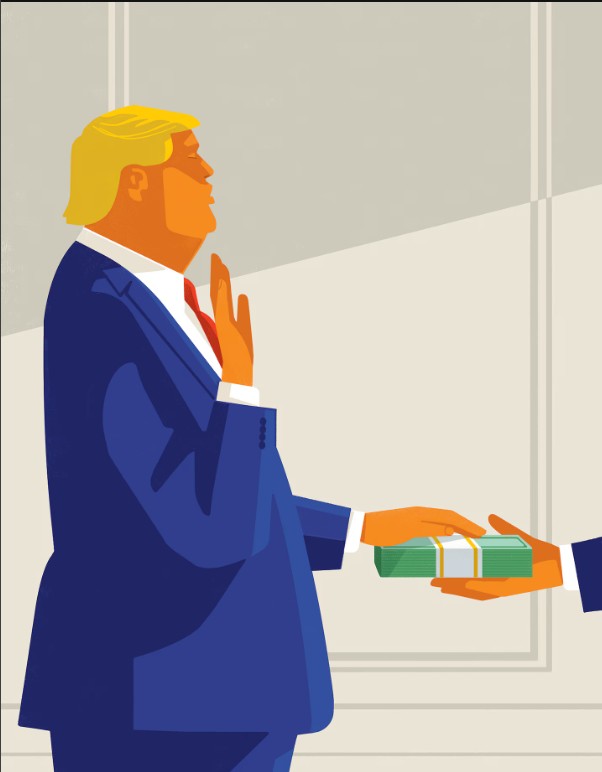
Though Trump might not be the most profligate rent-seeker -- that would be found somewhere in health care or agriculture or banking -- he is one of the most adaptable. Previously accustomed to lobbying for giant tax breaks, he has, as president, explored new rent-seeking avenues. He has turned the presidency into a branding machine that fills his coffers with cash. He has also become the grand dispenser of rent, deciding by himself which eager rent-seekers receive government benefits and subsidies.
Plunkitt valorized the honest graft of rent-seeking this way: "It's just like lookin' ahead in Wall Street or in the coffee or cotton market." In January 2016, Trump echoed Plunkitt when he explained why he had been so generous to both parties with campaign donations. "I've got to give to them, because when I want something, I get it. When I call, they kiss my ass," he said, voicing Plunkittism tenets in his Queens vernacular. For Trump, using government for self-enrichment and as a path to additional power has always been a guiding principle.
From the start of his business career, Trump played the conventional rent-seeker to make money. As a developer, he advocated the seizure of private properties through eminent domain, as pure an act of rent-seeking as there is. In Manhattan, he called in political favors for property tax abatements that ultimately cost the city $410 million in forgone tax revenue. He similarly pleaded for favors in New Jersey, where he needed state cooperation to maintain his gambling licenses. As NPR put it, in the mid-1980s, Trump "golfed and broke bread with nearly every major political power broker in the state," seeking tax breaks for his New Jersey casinos. "He turned one senator's office into his temporary headquarters, so he could use the phone in between lobbying legislators," the article explains. In rent-seeking fashion, Trump lobbied against the building of a state tunnel that would have provided a route to a rival's casino project.
After becoming president, Trump treated the national interest like a wrapper around his family business, working nonstop to turn the Resolute Desk into a cashier's counter. He extracted profit from his official position during his first administration, as he and his aides encouraged lobbyists, foreign officials, pardon-seeking criminals, and aspirants for ambassadorships and judgeships to swarm his hotels, golf courses, clubs and developments and to pay inflated prices -- rent, in economic parlance -- to gain potentially lucrative access to him. Vice President Mike Pence and his Secret Service retinue were steered by Trump himself to overnight during an official 2019 trip at his club in Doonbeg, Ireland, where they spent government dollars.
Since returning to the White House, Trump has hastened the hustle. The Wall Street Journal reported in May that Trump encourages Republican officials to stage events at his clubs, where he often appears. His latest financial disclosure statement showed him earning about $57 million from his investment in a Trump-family cryptocurrency company. The family has also raised $2 billion to start a bitcoin-mining company and created new meme coins. His Mar-a-Lago resort brings in about $50 million and his golf course and resort company brings in another $119 million. The disclosure also details royalties from his Trump Bible operations ($1.3 million), Trump sneakers and scents ($2.5 million), watches ($2.8 million), and about $1 million for a Trump guitar. The Trumps are peppercorning the globe with real estate developments in which the partners are foreign governments and foreign interests. The intertwining of the family's global business interests with foreign actors -- some of whom might be directly affected by the trade policy and diplomacy he commands -- will make it hard to distinguish national interest from private enrichment.
And this is only a short list of Trump's rent-seeking exploits. As his first biographer, Wayne Barrett, memorably observed of him, Trump has mastered the act of turning politics into money, which as dandy a definition of rent-seeking as you'll ever hear.
Rent-seeking is a two-act play. The seekers get the headlines, but the dispensers write the script by handing out the favors. Their essential contribution, often overlooked, is just as corrupting of the economy. Like Plunkitt before him, Trump has learned how to play a starring role in both halves of the drama -- but on a grander stage.
Rent-dispensers haunt nearly every branch of government: Congress, state and local governments, and agencies at all levels. Trump, it should be emphasized, isn't the first president to ladle out rent to the seekers. Andrew Jackson dispensed political spoils and banking favors. Franklin D. Roosevelt subsidized farmers. Barack Obama directed an $80 billion bailout of General Motors' and Chrysler's shareholders. Joe Biden fed the rent-seekers with green technology and energy subsidies, infrastructure handouts, and the Chips Act. But since vaulting into the White House, Trump has dedicated himself to the art of dispensing rent with the vigor he has long applied to seeking it.
If it's true, as Tom Waits once sang, that the large print giveth and the small print taketh away, Trump has learned how to compose with all the typefaces. During his first White House term, Trump gave Amazon's Jeff Bezos an expensive lesson in how the rent-dispensing game works. Bezos, who owns The Post, advertised his apparent disdain for candidate Trump in 2015 by tweeting "#sendDonaldtospace." Trump allegedly retaliated against Bezos -- presumably also for the newspaper's aggressive reporting on his presidency -- during his first administration by directing a $10 billion federal cloud-computing contract away from Amazon Web Services and to Microsoft. The source for this allegation? An Amazon legal filing asserted that the company lost the contract because Trump considered Bezos a "perceived political enemy." As comfortable dispensing rent as he was denying it, Trump treated the contract like "rent" that could be withheld to punish Bezos.
Fast-forward a few years and Bezos -- along with Meta's Mark Zuckerberg, another former Trump foe seeking friendly relations with the president, as well as Apple's Tim Cook and Google's Sundar Pichai -- attended Trump inauguration events. Both Meta and Amazon donated $1 million to the inauguration.
Mindful that they're dealing with a president who rewards loyalty and punishes dissent, the cream of corporate America -- including Adobe, BlackRock, Broadcom, Delta Air Lines, GM, Google, McDonald's, Microsoft, Nvidia, Pfizer, Target, Uber, Visa and Walmart -- lined up to donate to Trump's inauguration committee. It's relatively low-cost insurance to keep the dispenser-in-chief happy in case you need a favor down the line.
Even where there is no material government rent to dispense, Trump has acted as if there were. In February and March, Trump lacerated the legal elite with a slash of his Sharpie by issuing a set of punitive executive orders. The orders barred more than a dozen top U.S. law firms from entering select federal buildings, revoked and blocked security clearances, and disqualified the firms from holding government contracts. Essentially, Trump acted as if legal billings were rent that was subject to his approval and control.
The dispenser-in-chief's orders were preposterous: None of the firms were guilty of any true improprieties. His real beef was that they had represented his rivals, such as Hillary Clinton; they had represented or employed lawyers who investigated him, such as former special counsels Jack Smith and Robert S. Mueller III; they had worked for Dominion Voting Systems in its defamation suit against Fox News; or they had previously litigated against Trump positions.
Yet the president offered the law firms a way out. The executive orders could be canceled if the firms agreed to perform pro bono legal work. He suggested they represent police officers accused of misconduct, members of the military and first responders. In time, Trump expanded acceptable pro bono work to include legal labor on his trade deals. By April, Trump had successfully coerced nine top law firms into pledging almost $1 billion in pro bono services.
It was a remarkable twofer for Trump. First, he essentially created new political power over the legal elite out of thin air. By acting as a rent-dispenser, he treated lawyer income as if it was his to control. But he also acted like a rent-seeker, demanding that unearned legal services be provided for free to his allies.
The $TRUMP meme coin has increased the family's paper worth by billions without creating any genuine economic value. It's both worthless 21st-century memorabilia and a backdoor opportunity to bribe the president. George Washington Plunkitt would have been proud.
Going full crypto was a marked turnaround for Trump. In 2019, he derided crypto as "not money." But that was before learning how to cash in on his faithful by going crypto. Changing his mind, Trump has placed a variety of crypto bets. Just before his second inauguration, Trump helped create the $TRUMP meme coin. The New York Times describes him as tasting the life of a "cryptocurrency mogul." According to his recent financial disclosure report, he has earned about $57 million from his investment in the crypto firm World Liberty Financial, making it one of his most profitable enterprises.
Can we consider Trump's crypto forays as rent-seeking? Of course. It's hard to imagine succeeding in the crypto world -- at least as he has so far -- without the prestige of his office leading the way. Trump has done this time and again. Just last month, the Trump Organization announced a new mobile phone service that will feature golden smartphones. Nobody would pay much attention to his meme coins, his Bibles, his watches, his sneakers and now his mobile phones if not for his title. As economists like to note, products produced by rent-seekers rarely innovate or improve on what the market has produced. They benefit the rent-seeker at the expense of the consumer.
Short of sticking an envelope packed with Benjamins inside his coat pocket, there is no easier way to give Trump money than buying his meme coins. Chinese companies and other foreign interests have gotten this message, lining up to purchase tens of millions of dollars' worth of $TRUMP tokens. One domestic company, Freight Technologies, announced its plan in April to buy $20 million worth of $TRUMP, saying, "We believe that the addition of the Official Trump tokens are ... an effective way to advocate for fair, balanced, and free trade between Mexico and the US."
"Currently, people who wish to cultivate influence with the president can enrich him personally by buying cryptocurrency he owns or controls," said Sen. Jeff Merkley (D-Oregon). "This is a profoundly corrupt scheme. It endangers our national security and erodes public trust in government."
It surprised few when, shortly after its debut, $TRUMP's market price slumped. Having launched at $0.18, it peaked at $75.35 after a few days and has now settled at a little over $9. Trump dialed its value back up in the spring with the announcement of an "intimate private dinner" with him for its top 220 holders. The gala, held in late May, cemented the coin's reputation as an exercise in rent-seeking. $TRUMP's coin buyers, eager for their audience with Trump, spent upward of $148 million to qualify for the dinner list, Reuters reported. The dinner resulted in a rent-seeking payday for Trump's family, who profit from every $TRUMP transaction, even when its price declines. About 600,000 $TRUMP meme coin wallets have lost $3.87 billion this year. The family earned $320 million in transaction fees from the time of its introduction to early May.
The Trump family's crypto holdings, which include the $MELANIA meme coin, birthed just after $TRUMP, have topped $2.9 billion, according to an April report. Meanwhile, the United Arab Emirates-based fund has purchased $100 million worth of digital tokens from World Liberty Financial, which is majority-owned by the Trump family.
Every president now inherits rent-dispensing powers that would have been unimaginable to Plunkitt a century ago. In his first term, Trump helped himself to the Commodity Credit Corporation that essentially gave him a line of credit with the treasury to spend on farmers. But in his second term, he invoked his emergency powers to impose an endless series of emergency tariffs in the name of preserving national security.
Tariffs are among the most insidious forms of rent-seeking. Thanks to Trump's tariff policies, which grant certain businesses the power to charge higher prices and collect unearned profit, whole squadrons of lobbyists and company presidents have encircled the White House, pleading tariff indulgences of their own. It's only natural that Trump should demand something in return, because that's how rent-dispensing works: You give a favor, you take a favor, and the wheel turns.
Although Trump's emergency tariffs have been challenged in court, as long as they stand, they give him a way to dispense rents to the industries he favors, such as steel and aluminum manufacturers. By virtue of these powers, Trump can force whole industries to kneel before him, like Christopher Reeve before Zod in the White House in the 1980 Superman sequel.
Apple's Cook recently got schooled in the mechanics of rent-dispensing. Apple originally appeared to have dodged tariffs for iPhones. But then the president started jawboning the company over its plans to shift production from China to India, instead of the United States. Trump pumped up his rent-dispensing biceps and asserted his power over the company's supply lines. "We want you to build here," Trump says he told Cook.
General Motors CEO Mary Barra, who previously bowed before President Joe Biden when he was dispensing electric vehicle favors, is now happy to praise Trump's tariffs. If Bluey were to become the first Australian, female, cartoon-dog president tomorrow, Barra would learn to speak canine if that would help her win President Bluey's favor. Tariffs won't make the economy operate as Trump wants it to, but they do end up increasing his political power. To reinvoke Wayne Barrett's observation, Trump discovered long ago the alchemical formula that allows him to turn political power into money. For his purposes now, the two things are equivalent and satisfy the same hunger.
Like other rent-seekers and rent-dispensers, Trump doesn't seem to regard his grasping and presidential doling as wrong or destructive. Like Plunkitt, who once said, "With the grand opportunities all around for the man with a political pull, there's no excuse for stealin' a cent," Trump exhibits a preference for honest graft over dishonest graft. Repeatedly describing the political system as "broken" and "rigged" by various interests, he seeks rent and dispenses it not just with a clear conscience, but with a braggart's insistence that his actions are clever navigations of a corrupt system.
Whether cast in bronze or chiseled from rock, a George Washington Plunkitt statue in the National Garden of American Heroes would commemorate the style of the Tammany Hall legend and the 45th and 47th president in one swoop. Both treated public office as a chance to do business, both shamelessly unfurled the pirate flag of honest graft, and both subscribed to Plunkitt's pithy credo: "I seen my opportunities and I took 'em." Maybe Trump can arrange for the garden's designers to leave space next to Plunkitt for you-know-who.
When Donald Trump finally gets around to erecting his proposed $34 million National Garden of American Heroes, he should reserve a tall plinth for a bronze likeness of George Washington Plunkitt.
The National Garden, which is expected to feature about 250 statues of notable Americans such as Albert Einstein, Lauren Bacall, Sitting Bull, Douglas MacArthur, Fulton J. Sheen, Frank Sinatra, Margaret Chase Smith and Ida B. Wells, has a purpose. As Trump put it, it will "defend the legacy of America's founding, the virtue of America's heroes and the nobility of the American character."
Plunkitt might not be the equal of Thomas Jefferson or Ray Charles, two additional proposed honorees, and Trump might never have heard of him. But Plunkitt's example has served Trump throughout his career. The two men, separated by a century, are spiritual siblings, united by the belief that the highest uses of politics are to enrich yourself and punish your foes. By honoring Plunkitt, Trump would honor himself, a gesture not alien to a man who ordered a military parade through the streets of D.C. to coincide with his birthday.
Plunkitt -- a leading member of the Tammany Hall political machine at the turn of the 20th century -- was born in what is now Central Park, raised in poverty and under-schooled. From those modest roots, he rose to court voters like a Casanova, holding office at almost every level of New York government -- from state senator to assemblyman to alderman to police magistrate to county supervisor. Though this backstory is not very Trumpian, Plunkitt, like Trump, loved to speak his mind volubly, and usually contrary to the crowd's expectations.
Political historians remember Plunkitt primarily for his freewheeling conversations with journalist William L. Riordon, who collected and published them in 1905 as the sensational book "Plunkitt of Tammany Hall." There, Plunkitt analyzed the two ways officeholders could use their positions to garner personal wealth. They could rob directly from the public coffers, which Plunkitt conceded was wrong, calling it "dishonest graft." Or they could operate in a grayer, only slightly more ethical zone, and sell and trade political influence like a commodity. This, Plunkitt argued, was right and just, and he celebrated it as "honest graft."
Honest graft was when a politician shared information about an impending but not-yet-publicized government development plan -- such as the building of a new bridge -- with campaign donors and supporters so they could make a real estate killing. Honest graft was something to be proud of, Plunkitt held, and he believed politicians should swing such real estate deals for themselves if they could.
Scholars of political economy such as Anne O. Krueger and Gordon Tullock define the Plunkitt method of directing investment toward the politically connected as rent-seeking and look down their noses at it. Rent-seeking has nothing to do with the monthly check you cut your landlord. The cronyism of the rent-seeking process inevitably rewards incumbent companies at the expense of competitive ones, breeds inefficiencies, inspires corruption and misallocates resources.
Rent-seekers, found in almost every industry -- from defense to pharmaceuticals, agriculture to automobiles, banking to real estate -- expect government to act as the central dispenser of economic opportunity. They beg and cajole officials for the honest graft of loans, tariffs, subsidies, zoning waivers, no-bid contracts and all the other set-asides that constitute unearned rent. Previously in this series, we showed how the rent-seekers in the milk industry and among the computer-chip makers have relied on government power and influence to build their businesses and blossom their bank accounts.
Though Trump might not be the most profligate rent-seeker -- that would be found somewhere in health care or agriculture or banking -- he is one of the most adaptable. Previously accustomed to lobbying for giant tax breaks, he has, as president, explored new rent-seeking avenues. He has turned the presidency into a branding machine that fills his coffers with cash. He has also become the grand dispenser of rent, deciding by himself which eager rent-seekers receive government benefits and subsidies.
Plunkitt valorized the honest graft of rent-seeking this way: "It's just like lookin' ahead in Wall Street or in the coffee or cotton market." In January 2016, Trump echoed Plunkitt when he explained why he had been so generous to both parties with campaign donations. "I've got to give to them, because when I want something, I get it. When I call, they kiss my ass," he said, voicing Plunkittism tenets in his Queens vernacular. For Trump, using government for self-enrichment and as a path to additional power has always been a guiding principle.
From the start of his business career, Trump played the conventional rent-seeker to make money. As a developer, he advocated the seizure of private properties through eminent domain, as pure an act of rent-seeking as there is. In Manhattan, he called in political favors for property tax abatements that ultimately cost the city $410 million in forgone tax revenue. He similarly pleaded for favors in New Jersey, where he needed state cooperation to maintain his gambling licenses. As NPR put it, in the mid-1980s, Trump "golfed and broke bread with nearly every major political power broker in the state," seeking tax breaks for his New Jersey casinos. "He turned one senator's office into his temporary headquarters, so he could use the phone in between lobbying legislators," the article explains. In rent-seeking fashion, Trump lobbied against the building of a state tunnel that would have provided a route to a rival's casino project.
After becoming president, Trump treated the national interest like a wrapper around his family business, working nonstop to turn the Resolute Desk into a cashier's counter. He extracted profit from his official position during his first administration, as he and his aides encouraged lobbyists, foreign officials, pardon-seeking criminals, and aspirants for ambassadorships and judgeships to swarm his hotels, golf courses, clubs and developments and to pay inflated prices -- rent, in economic parlance -- to gain potentially lucrative access to him. Vice President Mike Pence and his Secret Service retinue were steered by Trump himself to overnight during an official 2019 trip at his club in Doonbeg, Ireland, where they spent government dollars.
Since returning to the White House, Trump has hastened the hustle. The Wall Street Journal reported in May that Trump encourages Republican officials to stage events at his clubs, where he often appears. His latest financial disclosure statement showed him earning about $57 million from his investment in a Trump-family cryptocurrency company. The family has also raised $2 billion to start a bitcoin-mining company and created new meme coins. His Mar-a-Lago resort brings in about $50 million and his golf course and resort company brings in another $119 million. The disclosure also details royalties from his Trump Bible operations ($1.3 million), Trump sneakers and scents ($2.5 million), watches ($2.8 million), and about $1 million for a Trump guitar. The Trumps are peppercorning the globe with real estate developments in which the partners are foreign governments and foreign interests. The intertwining of the family's global business interests with foreign actors -- some of whom might be directly affected by the trade policy and diplomacy he commands -- will make it hard to distinguish national interest from private enrichment.
And this is only a short list of Trump's rent-seeking exploits. As his first biographer, Wayne Barrett, memorably observed of him, Trump has mastered the act of turning politics into money, which as dandy a definition of rent-seeking as you'll ever hear.
Rent-seeking is a two-act play. The seekers get the headlines, but the dispensers write the script by handing out the favors. Their essential contribution, often overlooked, is just as corrupting of the economy. Like Plunkitt before him, Trump has learned how to play a starring role in both halves of the drama -- but on a grander stage.
Rent-dispensers haunt nearly every branch of government: Congress, state and local governments, and agencies at all levels. Trump, it should be emphasized, isn't the first president to ladle out rent to the seekers. Andrew Jackson dispensed political spoils and banking favors. Franklin D. Roosevelt subsidized farmers. Barack Obama directed an $80 billion bailout of General Motors' and Chrysler's shareholders. Joe Biden fed the rent-seekers with green technology and energy subsidies, infrastructure handouts, and the Chips Act. But since vaulting into the White House, Trump has dedicated himself to the art of dispensing rent with the vigor he has long applied to seeking it.
If it's true, as Tom Waits once sang, that the large print giveth and the small print taketh away, Trump has learned how to compose with all the typefaces. During his first White House term, Trump gave Amazon's Jeff Bezos an expensive lesson in how the rent-dispensing game works. Bezos, who owns The Post, advertised his apparent disdain for candidate Trump in 2015 by tweeting "#sendDonaldtospace." Trump allegedly retaliated against Bezos -- presumably also for the newspaper's aggressive reporting on his presidency -- during his first administration by directing a $10 billion federal cloud-computing contract away from Amazon Web Services and to Microsoft. The source for this allegation? An Amazon legal filing asserted that the company lost the contract because Trump considered Bezos a "perceived political enemy." As comfortable dispensing rent as he was denying it, Trump treated the contract like "rent" that could be withheld to punish Bezos.
Fast-forward a few years and Bezos -- along with Meta's Mark Zuckerberg, another former Trump foe seeking friendly relations with the president, as well as Apple's Tim Cook and Google's Sundar Pichai -- attended Trump inauguration events. Both Meta and Amazon donated $1 million to the inauguration.
Mindful that they're dealing with a president who rewards loyalty and punishes dissent, the cream of corporate America -- including Adobe, BlackRock, Broadcom, Delta Air Lines, GM, Google, McDonald's, Microsoft, Nvidia, Pfizer, Target, Uber, Visa and Walmart -- lined up to donate to Trump's inauguration committee. It's relatively low-cost insurance to keep the dispenser-in-chief happy in case you need a favor down the line.
Even where there is no material government rent to dispense, Trump has acted as if there were. In February and March, Trump lacerated the legal elite with a slash of his Sharpie by issuing a set of punitive executive orders. The orders barred more than a dozen top U.S. law firms from entering select federal buildings, revoked and blocked security clearances, and disqualified the firms from holding government contracts. Essentially, Trump acted as if legal billings were rent that was subject to his approval and control.
The dispenser-in-chief's orders were preposterous: None of the firms were guilty of any true improprieties. His real beef was that they had represented his rivals, such as Hillary Clinton; they had represented or employed lawyers who investigated him, such as former special counsels Jack Smith and Robert S. Mueller III; they had worked for Dominion Voting Systems in its defamation suit against Fox News; or they had previously litigated against Trump positions.
Yet the president offered the law firms a way out. The executive orders could be canceled if the firms agreed to perform pro bono legal work. He suggested they represent police officers accused of misconduct, members of the military and first responders. In time, Trump expanded acceptable pro bono work to include legal labor on his trade deals. By April, Trump had successfully coerced nine top law firms into pledging almost $1 billion in pro bono services.
It was a remarkable twofer for Trump. First, he essentially created new political power over the legal elite out of thin air. By acting as a rent-dispenser, he treated lawyer income as if it was his to control. But he also acted like a rent-seeker, demanding that unearned legal services be provided for free to his allies.
The $TRUMP meme coin has increased the family's paper worth by billions without creating any genuine economic value. It's both worthless 21st-century memorabilia and a backdoor opportunity to bribe the president. George Washington Plunkitt would have been proud.
Going full crypto was a marked turnaround for Trump. In 2019, he derided crypto as "not money." But that was before learning how to cash in on his faithful by going crypto. Changing his mind, Trump has placed a variety of crypto bets. Just before his second inauguration, Trump helped create the $TRUMP meme coin. The New York Times describes him as tasting the life of a "cryptocurrency mogul." According to his recent financial disclosure report, he has earned about $57 million from his investment in the crypto firm World Liberty Financial, making it one of his most profitable enterprises.
Can we consider Trump's crypto forays as rent-seeking? Of course. It's hard to imagine succeeding in the crypto world -- at least as he has so far -- without the prestige of his office leading the way. Trump has done this time and again. Just last month, the Trump Organization announced a new mobile phone service that will feature golden smartphones. Nobody would pay much attention to his meme coins, his Bibles, his watches, his sneakers and now his mobile phones if not for his title. As economists like to note, products produced by rent-seekers rarely innovate or improve on what the market has produced. They benefit the rent-seeker at the expense of the consumer.
Short of sticking an envelope packed with Benjamins inside his coat pocket, there is no easier way to give Trump money than buying his meme coins. Chinese companies and other foreign interests have gotten this message, lining up to purchase tens of millions of dollars' worth of $TRUMP tokens. One domestic company, Freight Technologies, announced its plan in April to buy $20 million worth of $TRUMP, saying, "We believe that the addition of the Official Trump tokens are ... an effective way to advocate for fair, balanced, and free trade between Mexico and the US."
"Currently, people who wish to cultivate influence with the president can enrich him personally by buying cryptocurrency he owns or controls," said Sen. Jeff Merkley (D-Oregon). "This is a profoundly corrupt scheme. It endangers our national security and erodes public trust in government."
It surprised few when, shortly after its debut, $TRUMP's market price slumped. Having launched at $0.18, it peaked at $75.35 after a few days and has now settled at a little over $9. Trump dialed its value back up in the spring with the announcement of an "intimate private dinner" with him for its top 220 holders. The gala, held in late May, cemented the coin's reputation as an exercise in rent-seeking. $TRUMP's coin buyers, eager for their audience with Trump, spent upward of $148 million to qualify for the dinner list, Reuters reported. The dinner resulted in a rent-seeking payday for Trump's family, who profit from every $TRUMP transaction, even when its price declines. About 600,000 $TRUMP meme coin wallets have lost $3.87 billion this year. The family earned $320 million in transaction fees from the time of its introduction to early May.
The Trump family's crypto holdings, which include the $MELANIA meme coin, birthed just after $TRUMP, have topped $2.9 billion, according to an April report. Meanwhile, the United Arab Emirates-based fund has purchased $100 million worth of digital tokens from World Liberty Financial, which is majority-owned by the Trump family.
Every president now inherits rent-dispensing powers that would have been unimaginable to Plunkitt a century ago. In his first term, Trump helped himself to the Commodity Credit Corporation that essentially gave him a line of credit with the treasury to spend on farmers. But in his second term, he invoked his emergency powers to impose an endless series of emergency tariffs in the name of preserving national security.
Tariffs are among the most insidious forms of rent-seeking. Thanks to Trump's tariff policies, which grant certain businesses the power to charge higher prices and collect unearned profit, whole squadrons of lobbyists and company presidents have encircled the White House, pleading tariff indulgences of their own. It's only natural that Trump should demand something in return, because that's how rent-dispensing works: You give a favor, you take a favor, and the wheel turns.
Although Trump's emergency tariffs have been challenged in court, as long as they stand, they give him a way to dispense rents to the industries he favors, such as steel and aluminum manufacturers. By virtue of these powers, Trump can force whole industries to kneel before him, like Christopher Reeve before Zod in the White House in the 1980 Superman sequel.
Apple's Cook recently got schooled in the mechanics of rent-dispensing. Apple originally appeared to have dodged tariffs for iPhones. But then the president started jawboning the company over its plans to shift production from China to India, instead of the United States. Trump pumped up his rent-dispensing biceps and asserted his power over the company's supply lines. "We want you to build here," Trump says he told Cook.
General Motors CEO Mary Barra, who previously bowed before President Joe Biden when he was dispensing electric vehicle favors, is now happy to praise Trump's tariffs. If Bluey were to become the first Australian, female, cartoon-dog president tomorrow, Barra would learn to speak canine if that would help her win President Bluey's favor. Tariffs won't make the economy operate as Trump wants it to, but they do end up increasing his political power. To reinvoke Wayne Barrett's observation, Trump discovered long ago the alchemical formula that allows him to turn political power into money. For his purposes now, the two things are equivalent and satisfy the same hunger.
Like other rent-seekers and rent-dispensers, Trump doesn't seem to regard his grasping and presidential doling as wrong or destructive. Like Plunkitt, who once said, "With the grand opportunities all around for the man with a political pull, there's no excuse for stealin' a cent," Trump exhibits a preference for honest graft over dishonest graft. Repeatedly describing the political system as "broken" and "rigged" by various interests, he seeks rent and dispenses it not just with a clear conscience, but with a braggart's insistence that his actions are clever navigations of a corrupt system.
Whether cast in bronze or chiseled from rock, a George Washington Plunkitt statue in the National Garden of American Heroes would commemorate the style of the Tammany Hall legend and the 45th and 47th president in one swoop. Both treated public office as a chance to do business, both shamelessly unfurled the pirate flag of honest graft, and both subscribed to Plunkitt's pithy credo: "I seen my opportunities and I took 'em." Maybe Trump can arrange for the garden's designers to leave space next to Plunkitt for you-know-who.