The Never-Ending War Between the White House and the Press
New York Times Book Review, August 25, 2020 Book ReviewsThe Presidents Vs. The Press: The Endless Battle Between the White House and the Media — From the Founding Fathers to Fake News, by Harold Holzer. 576 pp. Dutton. $30.
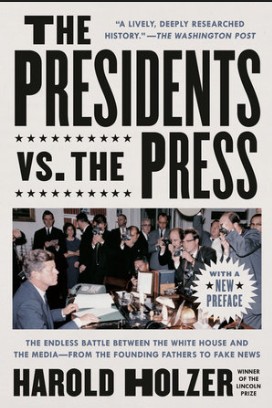 The next time President Trump chafes your free-speech sensibilities by yanking the White House credentials of a reporter who questioned him hard, insulting journalists at a news conference, tweeting about "fake news" being the enemy of the people or threatening to retaliate against one of the media outlets whose reporting has offended him, calm yourself by opening Harold Holzer's The Presidents vs. the Press to almost any page. For all of Trump's transgressions against the press--and they are many--Holzer's book offers evidence that he's not the greatest enemy of the First Amendment to have occupied the White House. He might not even rank in the top five.
Trump would definitely have to bow to both President John Adams, who signed into law sedition statutes used to prosecute journalists, and President Abraham Lincoln, who imprisoned scores of editors during the Civil War, purged news stories from the telegraph, banned some newspapers from the mails and even confiscated presses. "Altogether, nearly 200 papers would face federally initiated subjugation during the Civil War," Holzer writes. President Theodore Roosevelt, who actually enjoyed reporters, punished the press with a lighter touch. He established the "Ananias Club"--a symbolic place of exile--for reporters who displeased him, and he filed a libel suit against Joseph Pulitzer's New York World. President Woodrow Wilson reprised some of Lincoln's worst tendencies during World War I, imposing censorship of the press and pushing propaganda. And when it comes to President Richard Nixon, a man who once told his national security adviser, Henry Kissinger, "The press is the enemy," the question isn't where to start but where to end. Of the Nixon presidency Holzer writes, "Adversarial wariness gave way to open combat, inquiry to inquisition."
Holzer's fat volume gives us a panoramic survey of the most contentious president-on-press brawls from the past two and a quarter centuries, providing both the scholar and the general reader with valuable perspective on the current bout between Trump and reporters. The historic antagonism between presidents and the press is easily understood. Presidents regard information as power, and either hide it from their foes or reveal it on their schedule. They almost universally believe that reporters deliberately misread them. Journalists, the greatest of all Nosy Parkers, consider themselves the guardians of truth and oversight, and distrust what the powerful say.
Holzer focuses on 18 of the 45 presidents and avoids taking sides, although I've rarely seen President Bill Clinton so sympathetically portrayed. There will never be peace between the two institutions, Holzer implies, only varying levels of hostility. Students of the presidency and the press may be startled by the stink and temperature of the battle. (Disclosure: I'm cited twice by Holzer, both times neutrally.)
Historically, the press has given it to presidents as hard as it has gotten it. For much of the Republic's first century, when party control of newspapers was the rule, one set of papers would support the president while a separate set would oppose him--much like the way Fox News and MSNBC have tilted for Trump and Obama, only more so. Early in George Washington's first term, The National Gazette accused him of "wanting to be a king," and The Aurora made the baseless claim that he was stealing from the Treasury. Washington did not respond or retaliate, but his private letters abound with rage against the taunting newspapers. Adams, who followed Washington, cataloged the slights committed against him by reporters and did retaliate with the Alien and Sedition Acts, which criminalized journalistic dissent in the name of national security. Denied a second term, Adams rightly placed a portion of the blame for his defeat on the press, which defied his attempts at control. Once out of office, he complained that party-aligned newspapers kept their readers in partisan silos. Unexposed to competing ideas, readers came to think of every issue as a litmus test of party loyalty.
Holzer's best chapters are the ones on Lincoln and Theodore Roosevelt. An accomplished Lincoln scholar, he indicts the 16th president for waging an "undeclared, unlegislated, unlitigated and largely unchallenged war" on newspapers during the Civil War. But this condemnation of Lincoln's suppressive tactics comes with a sympathetic interpretation of the president's view that the Union could not be preserved without temporary limits on free speech and a free press. "Must I shoot a simple-minded soldier boy who deserts, while I must not touch the hair of a wiley [sic] agitator who induces him to desert?" Lincoln wrote in a letter. "I think that in such a case, to silence the agitator, and save the boy, is not only constitutional, but, withal, a great mercy." It's a tribute to succeeding presidents and to the journalists who resisted the clampdown that the measures were not extended at the close of wartime.
Theodore Roosevelt probably did more to alter president-press relations than anyone who has held the office before or since. Administrations had always steered politically gainful news to reporters, but Roosevelt actively courted journalists. He was the first to give White House reporters working space inside the building, enlisting them in a kind of partnership to create and disseminate news. He staged some of the first photo ops and invented the Sunday news drop, feeding the press a hot story for the Monday editions. The upshot of Roosevelt's constant flackery, as one reporter of the era put it, was "more scoops of White House origin during the Roosevelt period than before or since." Presaging Donald Trump, Roosevelt liked to deflect press corps interest in covering bad news by drowning them with racier news of his making. He fully expected to see himself on Page 1 every day.
Since the first Roosevelt, advances in technology have given presidents new ways to circumvent the press. Franklin Roosevelt leapfrogged reporters with his Fireside Chats on radio. (When Los Angeles's KFI dropped the chats in 1936, calling them "nothing more than campaign speeches," Roosevelt's people threatened to lift its re-election advertisements from the station.) John Kennedy burnished his image with television. Ronald Reagan advanced the news management techniques his predecessors had initiated, while Donald Trump has seized every technological advantage he can, from Twitter to cable news to Facebook, to sidestep the press corps' scrutiny.
Trump has become the punching bag for the contemporary press, and while he deserves many of his beatings, Holzer offers evidence that Barack Obama treated the press as poorly, only differently. Obama subjected reporters to the most invasive leaks investigations ever and intentionally concealed the workings of his presidency from public scrutiny, as top reporters attest. In one study of the Obama administration, the former Washington Post executive editor Leonard Downie Jr. wrote that its "war on leaks and other efforts to control information" were the most egregious Washington had seen since Nixon. The biggest difference between Obama's contest with the press and Trump's--questions of the vulgarian in chief's style aside--was that Obama masked his enmity for the press with a smile whereas Trump broadcasts his loathing for all the nation to see.
Both institutions have grown more powerful over the past several decades, and more jealous of the other's power, but neither seems ready to break or retreat. Yes, things are bad in the presidential press scrum, but they could be worse. Imagine the bedlam should presidents and the press set aside their animosity and join forces.